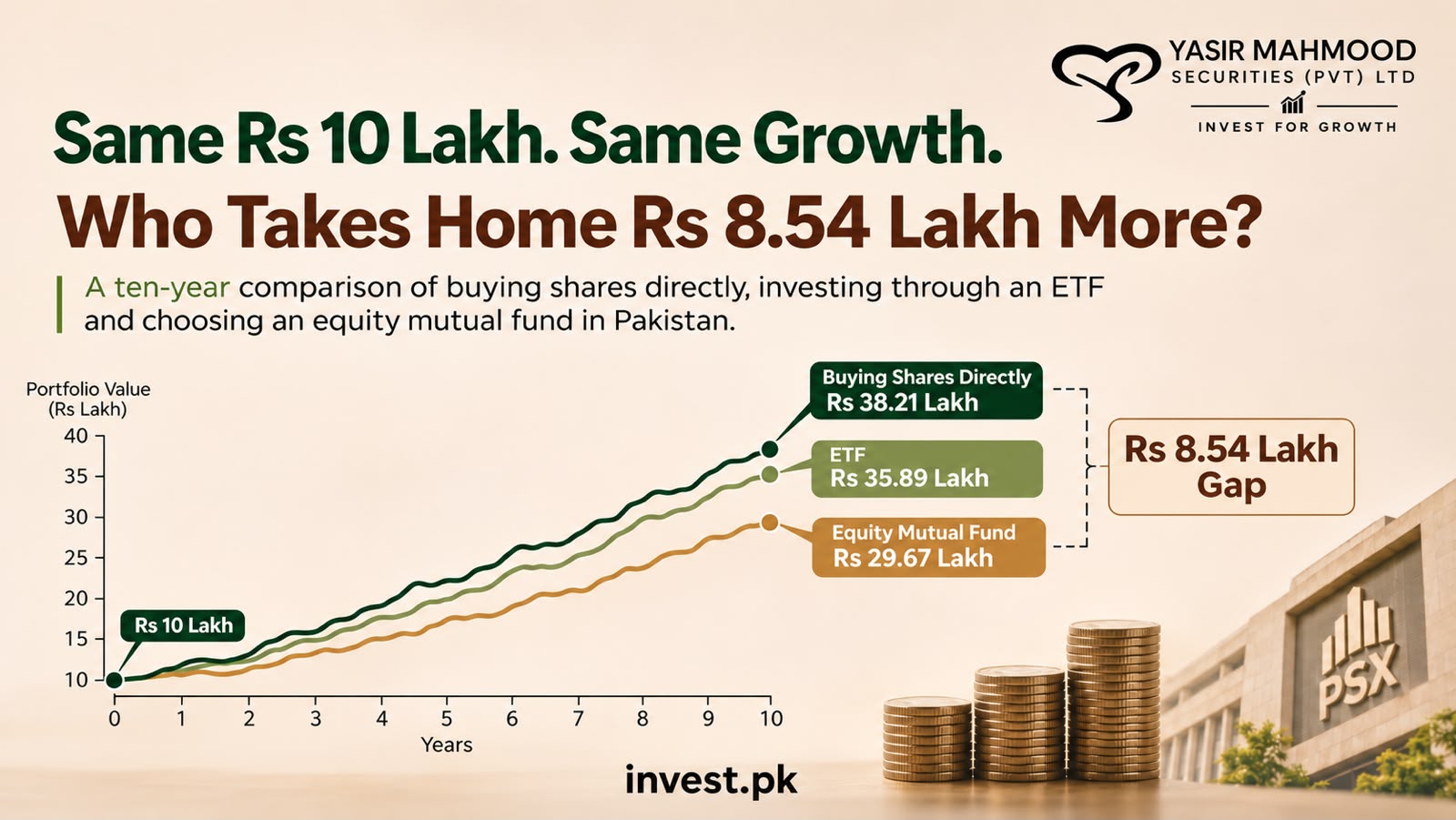
Imagine you and two friends each invest Rs 10 lakh in Pakistani stocks. You buy shares yourself. One friend buys an exchange-traded fund (ETF). The other buys an equity mutual fund. All three portfolios grow at the same rate before fees. Ten years later, you take home Rs 38.21 lakh. Your friend in the mutual fund takes home Rs 29.67 lakh. Where did the Rs 8.54 lakh difference come from?
For a starting point, Pakistan’s KSE-100 returned about 16% a year over the 35 years from November 1991 to November 2026, including dividends. For this example, assume prices alone rise 16?ch year and nobody receives a dividend. That gives all three routes the same starting line. Before fees and tax, each Rs 10 lakh would grow to Rs 44.11 lakh.
| How you invest | What you pay in this example | Cash after 10 years, fees and tax |
| Buy shares yourself | Brokerage commission and an annual account fee | Rs 38.21 lakh |
| Buy an equity ETF | Brokerage commission, an annual account fee and a 0.60% yearly management fee | Rs 35.89 lakh |
| Buy an equity mutual fund | 2% entry charge and a 3% yearly management fee | Rs 29.67 lakh |
What are you paying for?
With direct shares, you do the choosing. Say you want to own a bank, a cement maker and a fertiliser company. You decide which companies to buy and how much to put in each. Your broker charges a commission when you trade, and you pay the annual fee to maintain the account. You can hold those shares for years without paying a fund manager a percentage of their value. In return, it is your job to read the companies’ results and decide whether they still deserve a place in your portfolio.
With an ETF, one purchase buys a basket. You use a brokerage account just as you would for shares. Instead of placing a separate order for each company, you buy units of a fund that holds several companies for you. In this example, the fund follows an index. Its manager keeps the basket in line with that index and charges 0.60% a year. The convenience of buying and maintaining that basket leaves the ETF investor with Rs 2.32 lakh less than the direct investor over ten years in our example.
With an actively managed equity mutual fund, you hand over the decisions. The manager researches companies, chooses the shares and decides when to buy or sell. Here, the entry charge means a little less of your Rs 10 lakh starts growing on day one. The management fee then applies every year. On a portfolio worth Rs 10 lakh, 3% is Rs 30,000. On Rs 20 lakh, the same rate is Rs 60,000.
That explains why the gap gets so large. A rupee taken out in fees in the first year also loses nine more years of potential growth. If you enjoy following companies and can hold a spread of shares patiently, direct ownership gives you control and lets you keep more of a given market return. An ETF earns its fee by maintaining a basket for you. With an active fund, the question is whether the manager’s decisions and the time you save are worth the annual charge. In a real portfolio, those decisions can also change the return itself.
Conclusion
All three routes provide exposure to Pakistani equities, but they do not leave the investor with the same amount. In this example, direct shares produce the highest final value because the investor does the research and avoids an annual fund management fee. The ETF costs more but provides a ready-made basket of shares. The equity mutual fund costs the most because a professional manager makes the investment decisions.
The lesson is simple. Before investing, look beyond the expected return and ask what you will pay along the way. Even a small annual percentage can become a large amount over ten years. The best route depends on the time, knowledge and involvement you can bring, and whether the service you receive is worth the long-term cost.
Assumptions and sources
Investment and growth. One investment of Rs 10 lakh for ten years, with no further deposits or dividends. The historical reference is the KSE-100’s rise from 1,000 in November 1991 to 178,121.25 on 25 November 2026, about 15.96% annualised including dividends. The example uses 16% as assumed annual price growth for all three routes. PSX index methodology · November 2026 closing level
Brokerage and ETF. Each route is modeled separately using Yasir Mahmood Securities’ published delivery commission, 16% Punjab sales tax on commission and Rs 2,000 annual account maintenance, paid from the investment. The ETF’s assumed 0.60% annual management fee reduces its modeled growth to 15.40?fore brokerage and investor tax. YMS schedule of charges · Sales tax on brokerage
Mutual fund. The example uses the Meezan Islamic Fund’s 2% entry-load option, its published offer price and its 3% annual management fee. About Rs 9.78 lakh starts invested, growing at 13% a year before investor tax. This unit type has no exit charge. A different unit type can carry a 2% exit charge instead. Fund manager’s report · Published unit prices · Entry and exit terms
Tax and scope. The investor stays on Pakistan’s Active Taxpayers List. The calculation applies 15?pital-gains tax to taxable gains on sale and holds fees and tax rates constant for ten years. Other fund operating expenses, trading spreads and incidental levies are excluded. Figures are rounded. NCCPL capital-gains tax rates and calculation